A Reading List That Begins with a Question
Build a reading list around one open question to connect books and essays, choose relevant titles, and keep your reading focused without turning it into an assignment.
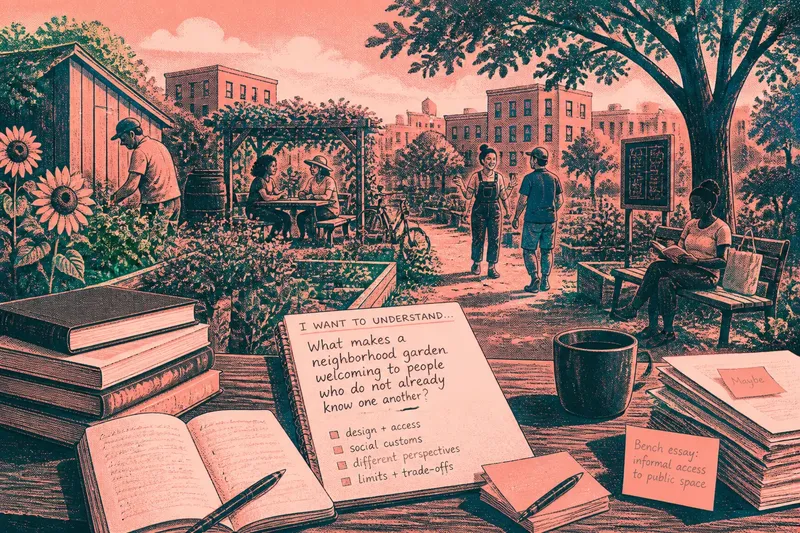
A reading list built around one open question is easier to shape than a pile of titles gathered under a broad interest. If you want to read about urban gardens, ask what makes a neighborhood garden welcoming to people who do not already know one another. That question gives you a direction without requiring a fixed number of books.
The question is a working lens, not a test with one correct answer. It helps you decide which books, essays, reports, or other long-form pieces might add a useful perspective. It also lets you set aside titles that share a topic but do not serve this particular line of inquiry.
Why does a broad interest make a reading list feel scattered?
A topic such as food, architecture, or memory can contain several different reading projects. A list about food might mix cooking technique, agricultural labor, restaurant criticism, and family traditions. Those subjects can all matter, but a shared label does not make them useful companions.
A question names the curiosity within the topic. “Is urban gardening good?” leans toward a verdict. “What makes a neighborhood garden welcoming to people who do not already know one another?” leaves room for design, access, social customs, and the limits of a garden’s influence.
Write the broad interest at the top of a page, then complete the phrase “I want to understand…” in ordinary language. If the result can be answered with a definition or a single fact, widen it. If it opens several unrelated interests, narrow it by naming a place, group, practice, or conflict.
Do not spend time polishing the wording for its own sake. A plain question that helps you choose a book is more useful than an elegant one that leaves you unsure what to read.
How can you make a broad reading question more focused?
A question can remain vague even after it has a question mark. “How do cities work?” could lead to planning, transport, housing, public space, local government, and much else. When every title appears relevant, the question may name a subject rather than a curiosity.
Give the question a boundary: a kind of place, a group of people, a recurring decision, or a point of disagreement. The boundary does not dismiss other material. It gives this particular reading list a workable center.
Say you are interested in public libraries but keep collecting books about education, civic design, architecture, and technology. You might ask, “How do neighborhood libraries make room for people who use them in different ways?” That wording gives you a reason to consider a book about library interiors, an essay about community services, or an account of quiet study. A general history of printing may still interest you, but it needs a clear connection before it belongs on this list.
When a candidate title seems loosely related, write one sentence describing what it could help you understand. If you cannot name that connection, set the title aside. That is a decision about the purpose of the list, not a judgment of the book.
How can you tell when a reading question is too narrow?
A question can quietly demand a specific answer. “Which city policy made this garden succeed?” assumes that one policy caused the result and that success is settled. That wording may steer you toward confirming the premise while excluding accounts that complicate it.
Look for language that assumes a cause, a winner, or a single outcome. “The best,” “the only reason,” and “why did this fail?” can be useful if you genuinely want to examine those claims, but they can close off inquiry too soon. Try asking about conditions, trade-offs, or different interpretations instead.
For example, “Why did this library redesign fail?” treats failure as established. “How did visitors and staff experience the redesign differently?” allows reading to reveal that a change helped one group while inconveniencing another. The revised question makes room for disagreement without pretending every account carries equal weight.
Ask whether two thoughtful sources could reach different conclusions and still help you. If not, check whether your wording is asking for understanding or demanding agreement.
What should you check before adding a title?
A shared keyword is not enough reason to add a book or essay. First identify the job it could do: offer background, describe a particular experience, clarify a policy, or challenge an assumption. Different forms of writing can illuminate different parts of a question, and no format is automatically more useful than another.
- Check the description or contents for a direct connection to your question; if you can name one, add the title with a short note, and if you cannot, set it aside.
- Check whether the title offers a perspective or context missing from the current list; if it adds something distinct, keep it, and if it repeats an existing role, treat it as an alternative.
- Check an introduction or sample passage for the concern you want to explore; if the relevant discussion is present, consider the title, and if it is absent, look for a closer match.
- Check whether you can explain the connection without relying on a shared subject word; if you can, record that explanation, and if you cannot, move the title to a separate maybe note.
- Check whether you would still want to read the item apart from completing this list; if yes, keep it as a genuine option, and if no, remove the sense of obligation and reconsider its place.
- Check whether the item opens a new branch rather than serving the question at hand; if the branch matters, start a separate note for it, and if it does not, leave the title out.
Say you have a list about who feels welcome in a neighborhood garden and find an essay about public benches. You read its description and see that it discusses who can linger in shared spaces. You add it with the note “informal access to public space.” Later, a general book about city history has no clear link in its contents or introduction, so you leave it in a separate maybe note rather than stretching the list to include it.
It is not worth arranging every candidate into a perfect reading order before you start. A brief note about each title’s possible role is enough to support a later choice. Keep the list provisional.
Why does a focused reading list keep growing?
A question can make discovery easier, but each source may point toward several more. A chapter mentions a writer, an essay names a debate, and a book’s bibliography opens another trail. The list can start to resemble everything you might read someday rather than a useful set of possibilities.
Finding a related title means you have encountered an option, not an obligation. Keep the main list for sources you can explain in relation to the question. Put interesting but distant recommendations in a separate holding note without promising yourself that you will eventually add them.
Distinguish between a source that opens the subject and one that deepens a thread already in view. If two titles seem to do the same job, choose the one whose description most directly matches your curiosity, or keep both as alternatives. You do not need to read both just because you found them.
A list does not need a fixed size to be useful. A new title earns a place when it contributes something the current options do not already cover.
What should you do when a book changes your question?
Sometimes a book does not answer your question so much as reveal that you have been asking the wrong one. You might begin by wondering how a garden attracts visitors, then realize that the more revealing issue is who has time to maintain it. That change is a sign of attention, not a failure of planning.
Pause and name what shifted. Did the source introduce a missing perspective, expose an assumption, or lead to a separate curiosity? Naming the change helps you revise deliberately instead of letting the original question disappear without notice.
Imagine you begin with “How do neighborhood gardens bring people together?” and read an account centered on maintenance. You notice that the account keeps returning to who has time and authority to care for shared space. You revise your question to “Who has the time and authority to care for a shared garden?” The new wording makes maintenance a central concern, so you keep the earlier title if it informs that concern and set aside candidates that only address social gatherings. The result is a narrower, more useful list, while the original question remains a record of how your interest shifted.
When the change is substantial, keep the old wording with a brief note about why it shifted. If the new question belongs to a separate topic, give it a separate list instead of stretching one list until its purpose becomes unclear.
How can you keep the question open without losing focus?
An open question should leave room for surprise, but it still needs a recognizable center. Revisit the wording when you add a source, finish one, or notice a recurring disagreement. Ask whether it still helps you choose what to read. If it does, there is no need to revise it simply because it is imperfect.
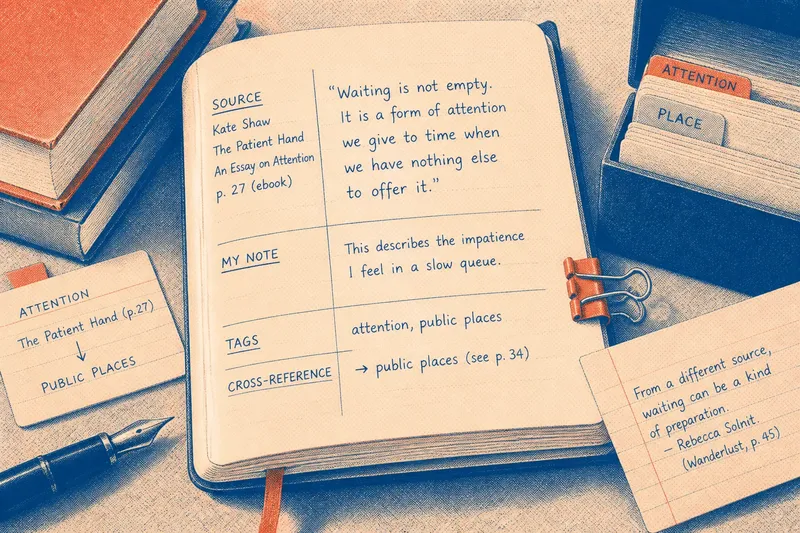
A short note beside each title can clarify its role. Words such as “public access,” “maintenance,” or “shared space” are enough. They help you see which parts of the question you have explored and which remain unfamiliar, without turning your reading list into a detailed record of every passage.
Leave room for different kinds of reading. A novel may illuminate a lived tension that an essay treats analytically; a local policy document may clarify terms that a memoir uses informally. Include an item when you can say what it might contribute, not because every list must represent every possible form.
Do not force balance for its own sake. If you want to understand one particular experience, a list centered on that perspective may suit your purpose. The useful check is whether you recognize what the list leaves out, not whether it contains a prescribed mix.
When should you revise a reading question?
What if I cannot find books that address the question directly?
Look for sources that approach one part of the question, or loosen the wording to include the terms writers use. A question about who feels welcome in a shared garden might lead to writing about public space, access, or community work even when those exact words do not appear in a title.
Should every item answer the same question?
No. One source may provide context while another challenges an assumption or describes a different experience. Each item needs a clear connection, but useful reading can complicate a question rather than settle it.
What if I lose interest in the subject?
Let the list rest or rewrite the question to match what now holds your attention. You do not need to finish the remaining titles before changing direction; a reading list is an aid, not a contract.
When should I start a separate list?
Start another when a new curiosity needs its own center and the original question can no longer explain why its titles belong together. Keep a note linking the lists if their subjects overlap, without forcing them into one collection.
What makes a reading question worth keeping?
A reading question is useful when it helps you choose and adjust what to read. It need not produce a tidy answer or fill a shelf. If you can explain why a source belongs, recognize when it does not, and change direction when your understanding shifts, the question is serving its purpose.
For a reading list that begins with a question, keep the wording where you make your next choice: at the top of a notebook page, in a phone note, or beside a short group of saved titles. Use it to decide what deserves attention, then let what you read reshape the question when a better one appears.