Paper Bookmark or Margin Tab? Two Ways to Mark a Passage
Choose a paper bookmark or margin tab based on how many passages you need to revisit, so you can find them later without adding marks you do not need.
A paper bookmark or margin tab changes how you return to a passage: one marks a place without attaching anything to the page, while the other leaves a visible cue at the book’s edge. If you are choosing between paper bookmarks and margin tabs, start with how many passages you expect to revisit and whether you want the pages to stay unmarked.
What does each method help you find?
A bookmark records a location indirectly. You place it at a page, then use the page layout, a line of text, or a handwritten cue to find the passage again. A narrow paper slip can carry a note such as “the paragraph about memory.”
A margin tab marks a page directly. Its edge stays visible when the book is closed, so you can open the book near the marked passage. Some readers write a short cue on the tab; others use colors to distinguish kinds of passages.
Neither method preserves the passage itself. If you need the exact wording later, copy it into a separate note or record it another way.
When is a bookmark the better choice?
Choose a bookmark when you want a clean page and usually have one current place—or a nearby group of pages—to revisit. It suits a novel, an essay collection you are reading straight through, or a borrowed book whose pages you do not want to mark.
A bookmark is easy to move as your attention shifts. Slide it to a new page, or add a brief handwritten clue if you need to remember an earlier passage. The book remains unmarked, and there is no adhesive to consider.
The trade-off is that one bookmark cannot point to several scattered passages at once. If you move it to your current page, an earlier location may be hard to find unless you recorded a page number or another clue. A bookmark is most useful as a current pointer, not as a map of the book.
When are margin tabs more useful?
Use margin tabs when several passages need to remain easy to find. A few visible markers can guide you back through a nonfiction chapter, help you compare an author’s claims, or collect sections for a discussion.
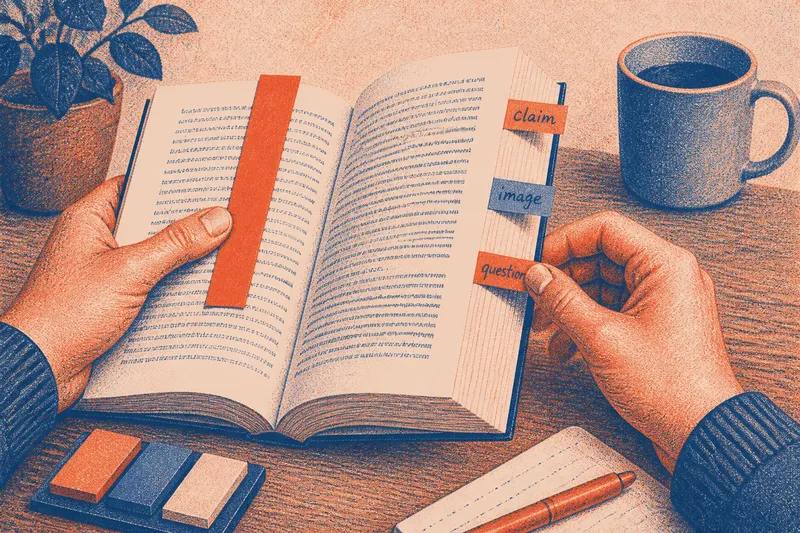
Tabs can carry brief labels. A word such as “image,” “question,” or “turn” can remind you why a page caught your attention. Keep the cue short; a tab is a locator, not a place for a full response.
The cost is visual clutter. A row of tabs can make a book’s edge busy, and adhesive may not suit every paper or binding. For a borrowed, delicate, or valuable book, a bookmark is the gentler default.
How do you choose between paper bookmarks and margin tabs?
Match the marker to the job. Decide whether you need one movable location or several persistent ones, whether you have permission to mark the book, and whether quick visual retrieval matters more than a clear page edge.
- One passage at a time: If you need one current location, use a bookmark; if the passage must remain findable after you move on, add a written cue elsewhere.
- Several passages in one book: If you expect to revisit multiple scattered pages, use a few tabs; if the book’s paper or binding is delicate, use separate bookmarks with written page cues instead.
- A borrowed book: If you do not own the book or are unsure about marking it, use a bookmark; if you have clear permission and the book can be marked safely, consider a tab.
- An uncluttered page edge: If visible markers would distract you, keep a bookmark; if finding selected pages quickly matters more, use only the tabs you will actually revisit.
- Passages with different purposes: If a simple color distinction will help you remember why you marked a page, assign each color one meaning; if you would have to memorize a complicated code, use brief written cues instead.
- Uncertain paper or adhesive: If the product directions and book-care guidance both allow the tab, proceed cautiously; if either leaves doubt, choose a bookmark.
Imagine you are reading a paperback essay collection and want to return to three passages for a conversation. You need to keep your place in the essay as well. Put a narrow bookmark at your current page, then place one tab on each selected passage, using short cues such as “claim” or “image.” When you reopen the book, the bookmark points to where to resume and the tabs lead to the passages; if you decide the edge looks too crowded, replace the tabs with separate bookmarks and written page cues.
It is not worth designing an elaborate color code before you know what you need to find. A few clear marks are easier to interpret than categories you have to memorize.
How can you keep tabs useful rather than distracting?
Place a tab near the passage, but do not let it cover text or interfere with turning the page. If you marked the page for a specific reason, write a short cue on the exposed part or in a separate note.
Use labels that help you act when you return. “Question” can remind you to revisit an unresolved point; “image” can help you find a detail you want to discuss. You do not need to classify every reaction. Mark only passages you have a reason to locate again.
For a book you expect to revisit, remove a tab when it no longer serves a purpose, but avoid peeling or repositioning it casually if the paper may be affected. A bookmark can handle temporary interest; reserve tabs for pages you intend to find again.
What if you want both methods?
Both can work when they have separate jobs. Keep a bookmark at your current place and use tabs only for a few passages you intend to revisit. That way, the bookmark does not have to record every interesting line, and the tabs do not have to show where you stopped reading.
For a delicate or borrowed book, use two bookmarks instead: one for your current place and another with a handwritten page cue for a passage worth revisiting. This keeps both markers removable while separating “where I am” from “where I want to return.”
Which marker fits common reading questions?
Are paper bookmarks better for borrowed books?
Usually, because they do not require adhesive on the page. Remove the bookmark before returning the book, and use a written cue if you need to remember a second passage.
Can margin tabs affect a book?
They may affect pages if the material or adhesive does not suit the paper, or if a tab is removed carelessly. Check the product directions and the book’s care guidance; if you are unsure, use a bookmark.
Are colored tabs useful for fiction?
They can help if you have a clear reason to revisit certain passages, such as recurring images or a character’s turning point. If you only need to remember your current page, a bookmark is simpler.
What should you write on a tab?
Use a short cue that will make sense when you return, such as “argument,” “image,” or “ending.” If the exact wording matters, record the passage separately rather than squeezing a quotation onto the tab.
How should you make the final choice?
Choose a paper bookmark for flexibility, a clean page, or one current location. Choose margin tabs when several selected passages need to remain visible and the book can be marked without concern. Use both when they serve different purposes, such as tracking your place and keeping a few pages easy to find.
For paper bookmarks or margin tabs, ask what you will need to locate the next time you open the book. The right marker is the one that makes that task clear without adding marks or a system you will not use.