Before the Reading Journal: Commonplace Books and Collected Passages
A commonplace book gathers passages and observations with their sources, helping you reuse ideas across books without turning each entry into a review.
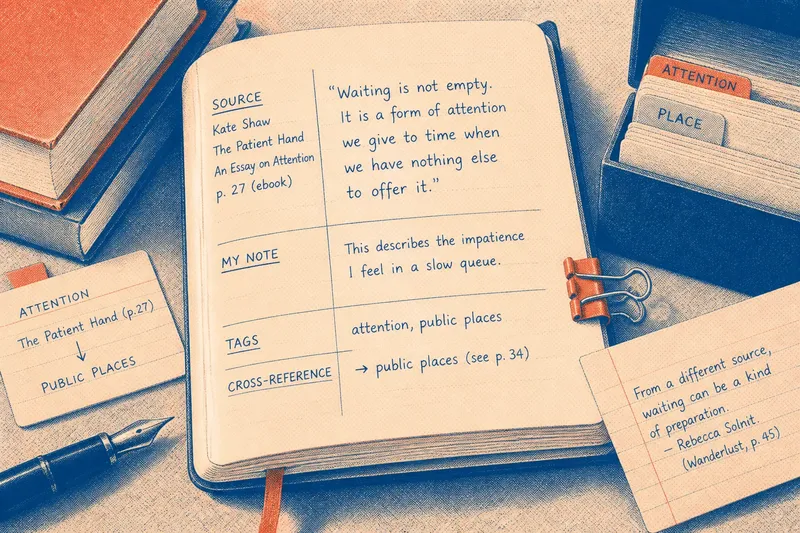
A commonplace book preserves selected passages and observations for later use; a reading journal records your experience of a book. That distinction shapes what belongs in each. If you want to remember titles and reactions, keep a reading journal. If you want to bring an idea from an essay into conversation with a novel, a commonplace book gives you a place to do it.
What makes a commonplace book different?
A commonplace book is a collection of material worth keeping beyond the moment you encounter it. An entry might be a sentence from a book, a detail from an essay, a question from a conversation, or an observation of your own. It does not need to document every reading session or explain a whole book.
The difference is the unit you preserve. A reading journal tends to be organized around a title and your response to it. A commonplace book is organized around the passage, thought, or connection itself. It can draw from several books and from ordinary life, so one subject may bring together material that would otherwise remain separated by publication date.
This distinction also helps keep a collection from becoming a second reading assignment. Save a passage because you can name what interests you about it, not because you feel obliged to record everything. An unfinished question can be a useful entry; a complete review is not required.
What should you record with a passage?
Keep enough source information to find the original again. For a book, that usually means the author, title, and a page, chapter, or section locator. For a web essay, record its title and author with a link or another identifying detail. Editions and digital formats differ, so choose the locator that works for the copy you used.
Make the boundary between source and commentary unmistakable. Use quotation marks, a label such as “My note,” or a consistent indentation. If you paraphrase, mark the wording as your own rather than making it look like a quotation. That small distinction prevents confusion when you return to an entry much later.
A short note on why you kept the passage can preserve its original context: “the image of waiting felt precise” is more useful than a bare excerpt if the reason has faded. But transcription does not need to become elaborate. Handwriting may help some readers attend to a phrase; typing may suit someone who wants to search a document. Neither format is inherently more faithful to the idea.
How can the format support connections?
Choose a structure that lets related ideas meet without forcing every entry into a rigid category. A paper notebook can reserve a contents page for broad subjects. A digital document or notes app can use a few consistent tags. Loose cards can be rearranged when a connection becomes clearer.
Broad headings such as “attention,” “place,” or “work” are often easier to use than a dense hierarchy. If an entry fits two subjects, add a cross-reference or a second tag rather than copying it in full. Repeated copying can make it harder to tell which version is current and where the source details belong.
What is not worth the effort is designing an elaborate classification system before you have entries to classify. Start with a small number of labels, and change them only when you have a real retrieval problem. The system should clarify the material, not become the main project.
Which record suits the job you have?
Choose the form by the answer you want to retrieve. A reading log answers, “What did I finish?” A reading journal answers, “What did I think or feel while reading?” A commonplace book answers, “Which passage or idea do I want to bring back into view?” These records can coexist, but they do not need to be combined.
- You want a list of titles and reading order. Check whether your main need is to remember completed books; if it is, keep a reading log, and if you also want to preserve particular ideas, add a separate commonplace entry for those passages.
- You want to reflect on a book as a whole. Check whether your notes mainly describe your response to the title; if they do, use a reading journal, and if a single passage stands apart, record that passage separately with its source.
- You are reading for a class or project. Check whether the notes must support an assignment; if they must, keep project notes organized around its sources and requirements, and if a thought has value beyond the project, copy that thought into your personal collection with clear attribution.
- You want to compare ideas across different works. Check whether you can name a recurring subject; if you can, collect related passages under a broad heading, and if the connection is not yet clear, preserve the entries in discovery order with a brief note.
- You are unsure what will matter later. Check whether you can explain why a passage caught your attention; if you can, save it with a source trail, and if you cannot, leave it uncollected rather than keeping it from obligation.
- You are deciding between paper and digital notes. Check whether you often need search or easy rearrangement; if you do, try a digital document or notes app, and if handwriting helps you stay attentive, use a notebook with a simple contents page.
Say you are reading an essay about attention and mark a sentence that changes how you think about waiting. In this invented situation, your starting point is one marked sentence, the essay’s title and author, and a page locator in your copy. You write the sentence in a notebook, put quotation marks around it, add the source details, and note, “This describes the impatience I feel in a slow queue.” You file it under “attention,” then add a cross-reference to “public places.” The resulting entry can later sit beside a passage from another work; the tradeoff is a little more writing now in exchange for context that will still be clear later.
What do readers ask about commonplace books?
Can a commonplace book include original thoughts?
Yes. An entry can be your own observation, a question, or a response to a passage. Mark your words clearly so they remain distinct from any source quotation.
Does a commonplace book have to be handwritten?
No. A notebook, loose cards, a notes app, or a searchable document can all work. Choose the format that makes it easy for you to capture material and understand it later.
How is a commonplace book different from a reading journal?
A reading journal usually follows your experience of a book, title by title. A commonplace book gathers selected passages and ideas, which can connect across different books and other parts of life.
What source details belong with a quotation?
Record the author and title, plus a page, chapter, section, or link that helps locate the passage in the version you used. Add a brief reason for keeping it if that context may not be obvious later.
How do you keep collecting manageable?
Begin with one entry that genuinely catches your attention. Record the material, identify its source if it has one, and write a plain note about what drew you to it. Let the collection’s contents—not a plan for a perfect system—show you which headings or formats are useful.
A commonplace book is most distinct from a reading journal when it helps you carry an idea between sources. The search phrase “commonplace book” points to that kind of collection: selected language and observations kept with enough context to be understood and found again. Keep the source trail attached, and a saved passage can remain useful without turning into a full review.