The Guilt of an Unfinished Book
The guilt of an unfinished book can turn reading into an obligation. Use a few reader-centered questions to decide whether to continue, pause, or let go.
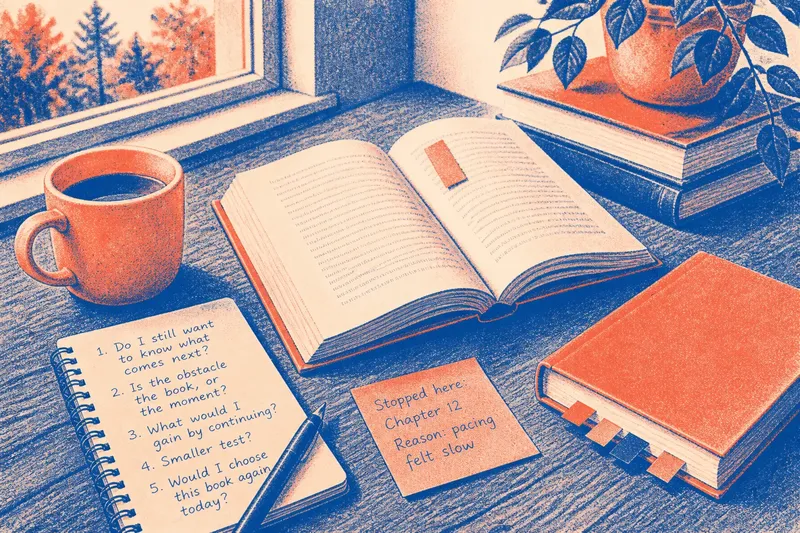
The guilt of an unfinished book can make a pleasure read feel like an overdue assignment. A book you began on the train, beside the bed, or during a quieter week does not become a debt simply because it remains open. The useful question is not whether you ought to finish, but what continuing would give you now.
Try these five questions when you are unsure. They are not a scorecard. Each helps separate a genuine wish to continue from habit, sunk effort, or a temporary mismatch between the book and your attention.
1. Do you still want to know what comes next?
For a novel, this may mean caring about a character’s choice or wanting to understand a mystery. In a history or memoir, it may be a question the next chapter seems likely to answer. The kind of curiosity matters less than its presence: if you catch yourself wondering about the book while it is closed, that is a useful reason to return.
Notice the difference between curiosity and duty. “I want to see how this argument develops” points toward a live interest. “I have already read so much” points toward time already spent. Past reading cannot be recovered by finishing, so it should not make the decision by itself.
Say you have stopped halfway through a novel because its opening chapters felt slow. Imagine that you still wonder whether the siblings will reconcile. You could read the next chapter during a quiet evening and notice whether that question becomes more compelling or fades. Either response gives you information; neither obliges you to continue afterward.
2. Is the obstacle the book, or the moment?
A book can be worthwhile and still be the wrong fit for a particular stretch of life. Dense prose may be hard to follow when you are tired. A painful subject can ask for more emotional attention than you have available. A short story collection may suit an interrupted schedule better than a sprawling novel, even if the novel remains appealing.
Ask what happens when you actually sit down with the book. If you become absorbed after a few pages, the barrier may be getting started. If you repeatedly lose the thread, feel tense, or wish you were reading something else, the mismatch may be real. The distinction helps you avoid treating every pause as a verdict on the book or on your reading habits.
When the obstacle is timing, pause deliberately rather than making a vague promise to “get back to it soon.” Put the book somewhere you will see it, add a note about where you stopped, and choose a natural point to reconsider it, such as after a demanding week or when your current read is finished. A pause can be a decision, not a failure.
3. What would you gain by continuing?
Consider the book’s likely value to you now. It might offer pleasure, a useful explanation, a vivid setting, or a conversation you want to join. You may also be reading it for a class, a book group, or a project. Those commitments can matter, but they are different from a private sense that every book must be completed.
Be specific. “I should finish because it is a classic” is less informative than “I want to understand why this narrator changes their mind.” A concrete reason gives you a way to judge whether the pages ahead are serving your purpose. If your purpose was simply to sample a writer’s style, you may already have learned enough.
There are ways to stay connected without reading every page. You might read the chapter headings, consult an index, or look at a carefully chosen review to see whether the book addresses your question. If you need the full argument or the pleasure of the prose, those shortcuts will not replace reading. If you only wanted orientation, they may be sufficient.
4. Is there a smaller way to test your interest?
When you cannot tell whether to continue or stop, make the next decision small. Read a few pages, one section, or through the end of a chapter. Then ask a plain question: am I more engaged, equally uncertain, or ready to move on? This is not a promise to finish. It is a limited way to hear your own response.
Choose a stopping point that makes sense for the book. A chapter break works for many nonfiction titles; a scene change may suit a novel. Avoid setting a demanding quota if the book already feels like work. The point is to notice your attention, not to prove endurance.
There is no need to annotate, summarize, or create a tracking system for every unfinished title. For a book you may revisit, a small slip of paper with the chapter or page and one sentence about your reason for pausing is usually enough. Elaborate records are not worth the effort unless you genuinely enjoy keeping them.
5. Would you choose this book again today?
Imagine seeing the book for the first time on a shelf today, with no memory of the pages you have already read. Would you take it home? This question can loosen the hold of sunk effort. It also makes room for changing interests: a book that suited a previous season of your life may no longer be the book you want now.
If your answer is yes, keep it within reach and give it another opening. If the answer is no, you can set it aside without turning that choice into a judgment about its quality. You may return later, pass it to someone else, or decide that you are done. A book does not have to be bad for you to stop reading it.
Think about how you want to treat the physical copy, too. A library book can be returned; a borrowed book can go back to its owner; a book you own can be shelved, shared, or donated. The practical next move often makes the emotional decision feel less abstract. If you want the option of returning, leave a note inside or place it with the books you plan to revisit.
What should you do when the answer is still unclear?
How long should I pause an unfinished book?
There is no required interval. Choose a point that fits your reason for pausing, such as when you have more quiet time or finish another book. If you cannot name a useful return point, it may be kinder to set the book aside for now.
Should I finish a book because I paid for it?
The purchase is already made, so finishing cannot recover its cost. Continue if the remaining pages offer something you want; otherwise, consider lending or passing the book on. You can also keep it without treating ownership as a reading contract.
Is it different to stop a book for a class or book group?
A shared commitment may give you a practical reason to continue, especially if discussion or coursework depends on the full text. If you cannot finish, check the group’s expectations and be honest about what you read. You can still take part by listening or discussing the sections you know.
Can I read the ending before deciding?
Yes, if knowing the ending will help you decide whether the book is worth your time. For some readers, spoilers reduce suspense; for others, they make a difficult or uncertain story easier to approach. Choose the kind of information that serves your reading, rather than following a rule about how books must be experienced.
Let the decision belong to the reader you are now
The guilt of an unfinished book often grows when finishing becomes a measure of discipline or respect. It is neither. Reading attentively, sampling a chapter, pausing during a difficult period, and stopping a book that no longer interests you are all legitimate ways to meet a text.
Use the five questions to choose one next action: continue, pause with a reason, or set the book aside. Keep your decision modest and revisable. If the book draws you back later, you can reopen it; if it does not, the shelf can hold a book you do not need to finish.